by Federico Soto Roland – Strategy, AI & Digital Director, NSB Agency
The scene plays out in hundreds of briefing meetings: "We don't need anything too creative…we want something simple, fast. A promo, a direct message. Price clearly visible. Strong offer, okay?"
The line sounds reasonable. Efficient. But it's the gateway to the club of interchangeable brands that all sound alike, look alike, and end up competing on price alone.
Other times it comes as: "We want something super-creative, something that breaks through…"—but when push comes to shove, the brand's decision-makers go with the same thing all their competitors do, scared off by the risk of being truly creative, or with budgets so low they don't pay for the creativity they claim to want.
The worst part: the data shows this approach destroys value over the medium and long term.
Want to sell more? You need ideas, not just discounts and big prices.
What really moves the needle in a campaign?
According to NCSolutions' study "Five Keys to Advertising Effectiveness" (2023):
. Creativity (49%)
It's the soul of the campaign. We're not talking about "tidy execution" or "following the brand manual," but about ideas that move people, make them laugh, unsettle them or leave a mark. When creativity shines, it generates twice (or three times) the results of any other factor. It's the difference between being remembered or being scrolled past.
. Brand (21%)
A brand isn't improvised. It's what makes you recognizable, trusted and loved. It includes consumer loyalty, market penetration and share of wallet. A strong brand turns every impression into sales more efficiently. If you're not building a brand, you're renting borrowed attention.
. Targeting (11%)
Hitting the right audience with the right message is essential. But beware: without powerful content, even the best targeting will leave your ad unnoticed. Targeting alone doesn't sell. Targeting plus a good idea does.
. Reach (14%)
The number of people you reach is still relevant, even if its weight has dropped relative to NCS's 2017 survey. Reaching more people with no context or differentiating message is like handing out flyers at the cemetery gates: lots of effort, little effect.
. Recency (5%)
How close to the moment of purchase the message is delivered. Useful, sure. But if the message has no spark, you can show it five minutes before the purchase and you still won't sell.
In other words, 70% of the impact comes from creativity + brand.
Not from segmentation, not from media spend, not from running the promo 20 times a day.
And this isn't just the conclusion of the latest NCS/Nielsen report; KANTAR reached similar conclusions back in 2020.
According to KANTAR (2020):
. Creative quality: 50% of the impact on media effectiveness
. Reach: 25%
. Frequency: 16%
. Media synergy: 9%
As their report puts it: "The quality of creativity is the main driver of media effectiveness." — Kantar.
And if you still have doubts, let's look at Wall Street
An academic study published in the Journal of the Academy of Marketing Science (2006) compared the stock-market performance of the 111 companies with the highest brand value (Interbrand ranking) against more than 13,000 companies in the broader market between 1994 and 2000.
Result: companies with stronger brands generated superior returns over 20 consecutive quarters.
Chart of stock-value performance per dollar invested:
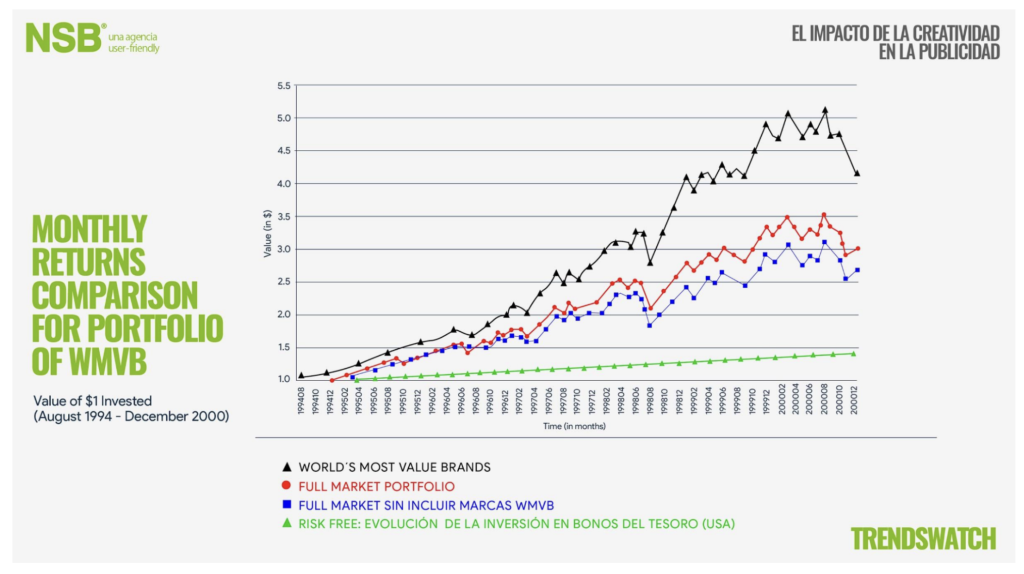
Source: NSB Trendswatch Report, 2016 – www.NSBagency.com
Short-termism: an expensive temptation
Of course, functional, informational, low-budget campaigns can bring some immediate results.
But that kind of communication:
. Doesn't differentiate
. Doesn't build a brand
. Leaves no emotional imprint
. And above all, doesn't build loyalty
In our 2016 TrendsWatch Report we already said it plainly: "the proliferation of functional, informational campaigns with no voice of their own has created a bubble of advertising irrelevance. It gets produced, it gets bought, it gets reported… but it isn't remembered."
Repeating what everyone else does isn't efficiency. It's symbolic suicide.
When every brand puts prices in giant type, uses the same white-background layout with a product shot, and communicates "benefits" literally, then none of them is building a brand. They're just trying to close out the month without looking at the year. And meanwhile, the brands that invest in creativity and identity keep winning share, recognition and pricing power.
Cheap doesn't just cost you dearly—it makes you invisible
Creativity costs money.
So does strategy.
But both multiply the return on every peso invested in media.
As the data shows:
. A creative piece can generate up to 7 times more incremental sales than a weak one (NCS, 2023)
. Creativity improves average efficiency by 50% (Kantar, 2020)
. Strong brands generate more sustained stock-market value (Journal of Marketing Science, 2006)
Conclusion (uncomfortable, but real)
Many clients who don't want to pay for creativity are, in fact, choosing to compete on price. They're saying: "I want to sell the same thing as my competition, but with fewer differentiating resources." And that, in a world saturated with messages, is a recipe for irrelevance.
Want to break out of that loop?
Invest in what generates real value:
. A powerful idea
. A brand with a voice of its own
. A narrative that connects
. And a tone that isn't interchangeable with your competition's
Want results? Start with the difference.
And that, to a large extent, comes from creativity and a strong brand.
At NSB we work on it every day. And we know what it's worth.