By Federico Soto Roland — Strategy, AI & Digital Director, NSB Agency.
An honest disclaimer before we start: this is not an anti-AI piece.
It would be pretty hypocritical to write that from an AI-First & User-Friendly agency. AI is already part of the creative, strategic, production, and sales process of any brand that wants to compete seriously. Denying it is nostalgia dressed up as principle.
But something more interesting is happening beneath the surface: the cheaper the synthetic gets, the more value the human can win back.
Not for every brand. Not for every audience. Not for every category.
But yes for luxury brands, premium brands, high-budget brands, and brands with an artisanal heritage that can show that behind what they sell there's something AI still can't manufacture: human time, craftsmanship, sensitivity, risk, judgment, error, emotion, and physical presence.
The next frontier of luxury might not be "more technology."
It might be being able to say, and prove: a person made this.
The Anti-AI movement isn't a fad: it's a cultural reaction
The public conversation about AI has already moved past pure fascination.
Pew Research Center found in 2026 that 52% of American adults feel more concerned than excited about the increased use of AI in daily life. Among adults aged 18 to 29, concern reached 55%, versus just 11% who were more excited than concerned.
Ipsos shows a similar tension: its AI Monitor 2025 found that 52% say they're excited about products and services that use AI, while 53% say AI makes them nervous.
That's the tension brands need to understand.
People don't necessarily hate AI. In fact, they use it, they try it, and plenty of the time they need it. But when AI enters symbolic territory —art, beauty, luxury, identity, creativity, emotional connection— another question appears:
What am I really buying: a thing, or the human story behind that thing?
Luxury has always sold more than product
Luxury was never just expensive materials. It was a signal.
A signal of money, yes. But also of taste, access, time, belonging, rarity, and knowledge. The handbag, the watch, the perfume, the hotel, or the dress works as both an object and a message.
That's why AI introduces a fundamental problem. If visual, written, musical, photographic, or even design production becomes infinite, instant, and cheap, then volume stops being a differentiator.
The question is no longer who can produce more.
The question is who can produce something that feels less replaceable.
That's where a strategic opportunity appears: the human as the new verifiable luxury.
Not human as a soft campaign claim. Human as a system. As traceability. As ritual. As visible process. As an artisan with a first and last name. As a decision not to optimize everything. As a conscious renunciation of total efficiency.
In other words: craft as anti-synthetic positioning.
The luxury data was already warning us
The luxury industry doesn't come to this conversation from a comfortable position.
Bain estimated that price increases and a creativity crisis cost luxury brands between 60 and 70 million customers in two years, shrinking the global base by around 18%, to roughly 330 million buyers. The problem wasn't just price. It was the disconnect between price and perceived value.
That's key.
When a brand raises prices without raising meaning, it's charging a tax. When it raises prices because it can demonstrate more craft, more truth, more real scarcity, and more emotional value, it's charging a premium.
Kearney, in its Global Luxury Industry Outlook 2026, found that 63% of luxury consumers define luxury primarily by quality and craftsmanship; 66% research extensively before buying; and only 9% say they buy based on trends.
McKinsey and Business of Fashion add another important data point: in the United States and China, emotional connection now shows up as a central driver of brand desirability, ahead of traditional markers like craftsmanship, heritage, and exclusivity.
That doesn't mean craft stopped mattering.
It means something more uncomfortable: craft alone is no longer enough; it has to become emotionally relevant.
Craft can't be a museum.
It has to be desire.
Handmade has a psychological advantage
The idea that handmade is worth more isn't just romanticism.
Marketing research talks about the "handmade effect": handmade products can be perceived as if they symbolically "contained love," and that increases purchase intent and willingness to pay, especially when the object serves an emotional function.
That finding gets more interesting in the age of AI.
Before, the comparison was handmade versus machine-made. Now it's starting to be human-made versus AI-generated.
And they're not the same thing.
Industrial production could still involve a factory, workers, raw material, friction, logistics, wear and tear. The synthetic, on the other hand, threatens to skip the part we culturally associate with creative effort: the hand, the eye, the delay, the intention.
That's why a product, a campaign, or an experience that is "100% human" can become a status symbol.
Not because it's objectively better in every case.
But because it's more expensive to produce, harder to scale, and easier to load with meaning.
The problem with AI in luxury isn't AI: it's the perception of lower effort
There's a trap in many discussions about AI and creativity: they analyze the quality of the output but ignore the cultural reading of the process.
A study published in the Journal of Advertising Research on AI-generated luxury ads found that disclosing the use of AI can lead consumers to perceive less effort, which lowers the ad's perceived authenticity and worsens the response to the piece.
The point isn't that AI produces "ugly."
The point is that, in luxury, the consumer also pays for the expectation of effort.
The Nuremberg Institute for Market Decisions reached a similar conclusion: when the same ad was labeled as AI-generated, consumers tended to rate it as less natural and less useful than when it was labeled as human-made; they were also less willing to research or buy the product.
This is the strategic crux.
For many categories, "made with AI" can mean innovation, speed, or personalization.
For luxury, it can trigger a different reading: shortcut.
And luxury can't look like a shortcut.
Luxury needs to look like the long road.
"Exclusively human" as the new show-off
There's an obvious form of ostentation: big logos, high prices, visible access.
But luxury has also evolved toward subtler signals: knowing which atelier made it, understanding where a leather comes from, recognizing a stitch, getting into a closed experience, having a relationship with an advisor, belonging to a circle that gets it.
In that context, "this was made without AI" can become a new form of cultural capital.
It wouldn't be a show-off of raw wealth. It would be a show-off of judgment: I can afford what wasn't optimized, automated, or synthesized.
As with organic, handmade, signed, numbered, bespoke, analog, vintage, or limited-production goods, the value isn't only in the function.
It's in the story the buyer gets to tell about themselves by choosing it.
"I didn't buy the most efficient output.
I bought the most human process."
That positioning isn't going to be mass-market.
That's exactly why it can be valuable.
The opportunity: use AI behind the scenes, sell humanity out front
There's a fundamental distinction here.
A brand can use AI internally to research, prototype, simulate, analyze, test, or speed up processes. That doesn't necessarily contradict a human-centered positioning.
The problem appears when AI replaces what the brand promises as its source of value.
BCG, in its take on AI in fashion & luxury, lays out a pretty sensible tension: protect brand, exclusivity, and authenticity from homogenization; make sure craftsmanship remains central; and use AI to accelerate or augment capabilities, with humans setting the vision.
That may be the most realistic formula:
AI-powered on the inside. Human-led on the outside.
AI to expand possibilities.
Humans to decide what deserves to exist.
AI to explore.
Craft to validate.
AI to accelerate.
Human ritual to justify the premium.
The brand doesn't have to become Amish.
It has to know which part of its value it can't outsource to the algorithm.
Which brands can take an Anti-AI stand
Not all of them.
Anti-synthetic positioning makes sense when the brand meets at least one of these conditions:
- It has real craft to show. Workshops, artisans, designers, processes, materials, proof, discards, time.
- It sells emotion, not just performance. Fashion, jewelry, fragrance, art, hospitality, gastronomy, design, premium beauty, experiences.
- It can charge for real scarcity. Limited editions, numbered pieces, bespoke, made-to-order, slow production.
- It has audiences with cultural capital. People who want to set themselves apart not just by buying expensive, but by buying "well."
- It can sustain the promise operationally. If the campaign says human-made but the product, the content, and the customer service smell like cheap automation, the house of cards falls.
The last one is the most important.
Because anti-AI can be a powerful position, but it can also become the new greenwashing.
Let's call it humanwashing: brands using the aesthetics of the human without paying the cost of producing humanly.
How it translates into communication
A brand that wants to claim this territory shouldn't come out with a grandiose manifesto against technology.
It should do something harder: show the process.
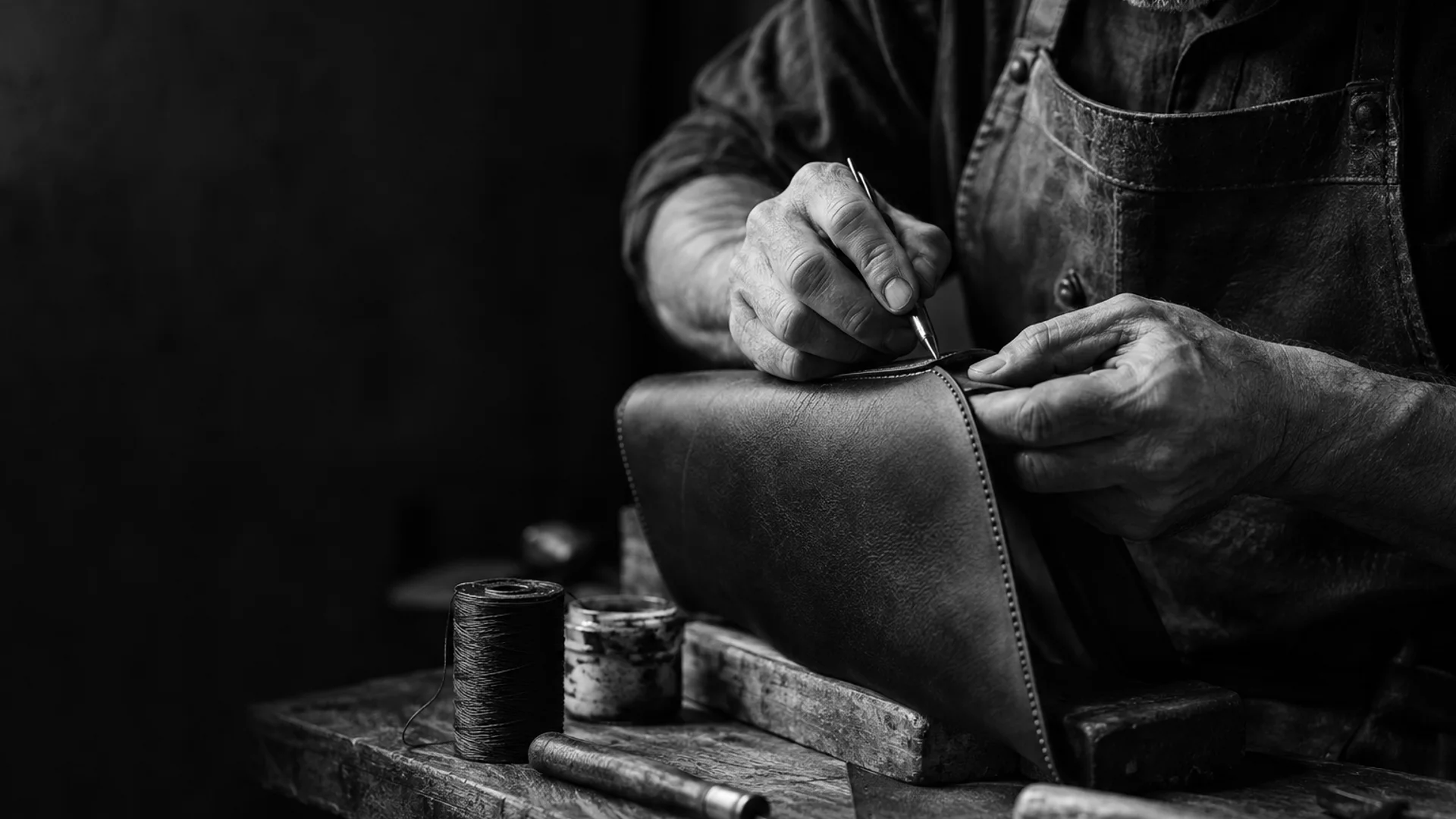
Show hands. Show waiting. Show failed tests. Show materials. Show names. Show workshops. Show decisions. Show why something takes time. Show why it costs what it costs. Show why there aren't infinite units. Show which part was human, which part was assisted, and which part is never delegated.
Anti-synthetic luxury isn't built by saying "we hate AI."
It's built by saying:
- this was designed by a person;
- this was finished by hand;
- this has a variation that can't be replicated;
- this has authorship;
- this has provenance;
- this has time inside it;
- this wasn't made to look perfect, but to feel alive.
The aesthetics change too.
Less perfect plastic. Less poreless skin. Less hyper-clean visuals with a whiff of AI. More texture, shadow, grain, material, voice, presence, controlled accident.
Imperfection is going to become a credential again.
The risk, obviously, is turning a truth into a pose: talking about craftsmanship with stock images, about emotion with batch-generated copy, or about authorship with no author. That would be the new humanwashing: brands using the aesthetics of the human without paying the cost of producing humanly. And in luxury, where the consumer is buying proof of difference, that act doesn't last long. AI doesn't destroy craft; it forces it to prove itself.
What it means for your brand
If your brand competes on price, volume, or speed, this probably isn't your territory.
But if your brand competes on desire, salience, reputation, experience, or premium pricing, the question is no longer just how you'll use AI.
The question is what you'll protect from AI.
Which part of the process has to stay human for the brand to keep its value. Which part is worth making visible. Which part can become ritual. Which part can be certified. Which part can be narrated. Which part can justify someone paying more.
Because in a world where anyone can generate a thousand versions of anything in seconds, scarcity moves somewhere else again.
Scarcity is no longer producing.
Scarcity is having been produced with intention.
AI is going to make a lot of brands look more like each other.
Craft can be a way out of the sea of sameness.
And maybe the next luxury isn't having something perfect.
Maybe the next luxury is having something that still has a person inside it.
Main sources consulted
- Pew Research Center — concern and excitement about the growing use of AI in daily life.
- Ipsos — AI Monitor 2025.
- Bain / AP — loss of luxury buyers and the decoupling of price, creativity, and perceived value.
- Kearney — Global Luxury Industry Outlook 2026.
- McKinsey & Business of Fashion — State of Luxury 2026.
- Journal of Marketing — research on the "handmade effect."
- Journal of Advertising Research — study on the perception of AI-generated luxury ads.
- Nuremberg Institute for Market Decisions — research on transparency, trust, and ads labeled as AI.
- BCG — perspectives on AI in fashion & luxury.