By Agustín Jofré – Graphic Designer, NSB Agency.
Let me start this piece with an exercise: close your eyes and imagine you're looking at your phone, you open your go-to social network and you see a post from your favorite brand, you like it out of habit, then you keep scrolling and see another very similar post from another brand, a similar post, but you don't like it, you scroll and see another brand with a post almost identical to the previous one, then another, and another… You stare at the wall for a few seconds and start thinking, "damn, everything looks the same now."
That little example, based on a true story, was the trigger for the idea of writing about "blanding," a term that comes from blending the words bland and branding. It's a trend where brands all communicate the same way, talk about the same things, behave the same, as if all those brands had the same mother telling them what to do. As I said before, everything is becoming more plain, more dull, more flavorless.
So, what exactly is blanding?
As I briefly mentioned in the paragraph above, blanding is a modern term for something bland, pointless, devoid of idea or visually dull, within the world of branding. Some people online say blanding is just badly done branding, and I don't agree.
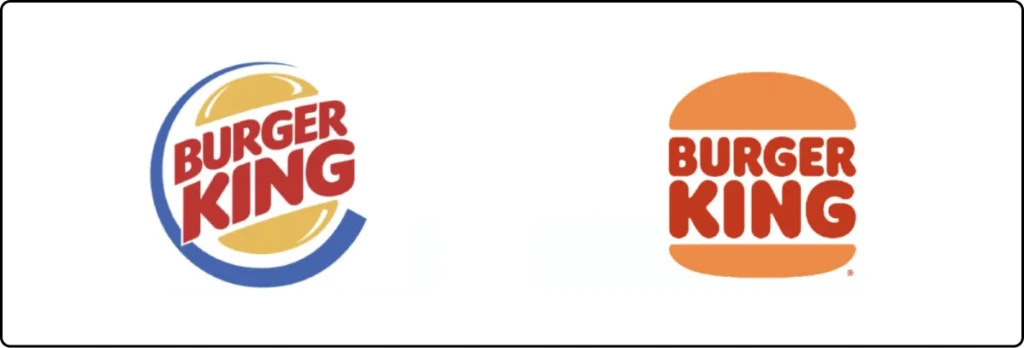
We can spot it nowadays when big brands announce the redesign of their logo — take Burger King's logo being redesigned, for instance, and in the process losing every bit of brand expression to become something less charming, more corporate and less fun. It's as if they stopped selling burgers and started selling home decor items. (Yes, that's what the current logo tells me, and there's no reason for it.)
When I think of bland design, we might think of minimalism, but we couldn't be more wrong. Don't confuse minimalism with blanding, nor flat style with blanding. To complicate things a little more, a brand is dull because it lacks an idea, whereas a minimalist brand takes its idea to the minimum.
Pros and cons.
Every trend is worth analyzing, and in this case I'm going to give my opinion as a designer and as a consumer. Spoiler: it's not all bad.
The main reason brands adopt blanding as their core idea is its appeal of acceptance — it makes you feel safe, with a simple logo, simple colors, you offend no one. They're brands that are easy to understand: you see them and you get it, and that's appreciated in today's world. A great example is Apple, that white, pure brand that communicates like so many others but at one point knew how to own its motto "Think Different."
Another reason for blanding is cost: the time it takes to produce a simple visual is less than for a complex one, which in money terms means savings.
But it's not all as simple as it seems — having every brand communicate the same way makes you boring. As a consumer too: imagine you go to the supermarket to buy 0000 flour, and every package says 0000 flour with a white container and a drawing or image of wheat. No brand breaks the mold, no brand dares to communicate differently. But your brain would get pure dopamine if it saw an eye-catching pack, a different color, something different.
If every brand were to bet on or adopt blanding, we'd lose something crucial — we'd lose creativity; that human way we have of making ourselves noticed, of standing out, of showing authenticity. We'd lose thousands of ideas that connect with the audience, ideas that move people, that grab attention, and even ideas that could make you "go viral" in today's world.
How long until people get bored of brands like that? That's a nice question, and a study by Kantar and BrandZ shows us that the most disruptive brands saw a 28% increase in brand value.
So, is it good or bad?
Technically, blanding in itself isn't bad.
I'd like to end this piece with a tricky question, a question I can't answer, but you can. It's up to you whether you want a brand that communicates like all the rest, or a brand that dares to change. Do you want a white 0000-flour pack with an image of wheat, or do you want a pack that grabs attention, that makes people pick it up, look at it, and get interested?
At least from my side as a designer, I know both approaches are valid, and I'll always look for what's best for your brand, but I'm also aware that trends are temporary, and if you dare to change, you're already ahead of the curve.