by Federico Soto Roland, Strategy, AI & Digital Director at NSB Agency
The advertising industry tends to fall fast for the latest gadgets and new technologies. It happened with the metaverse, augmented reality, the "performance-can-do-anything" craze, and now it's happening —faster and deeper— with artificial intelligence. The problem is that AI has, and will have, a far greater impact on our business, and that, as Dario Amodei warns, we're entering a stage of immature technological power.
Advertising is one of the first arenas where that immaturity becomes visible. Not because AI is going to "replace us," but because it's changing what counts and what stops counting in our work.
At the same time, it's already starting to affect —and will do so far more disruptively in the short term— how we charge for our work, mainly because the number of hours spent developing an idea or a campaign won't hold the value it needs unless that value is filtered through the experience and the years of seniority of whoever decides what to do and what not to do.
Creativity and content: from differentiating craft to accelerated commodity
AI can already generate concepts, copy, visuals, scripts, key visuals, adaptations and variations at a scale that breaks one of the industry's historical foundations: the idea as a scarce resource – and it will do so frighteningly better in just a few months or a couple of years! That doesn't eliminate creativity, but it does dilute its unit value; creativity stops being valuable simply for existing and starts being valuable for the judgment that holds it up (a person who thinks and decides!). It was always this way, but from now on it will be even more so, since execution will be more commoditized.
In this scenario, the hard part will no longer be producing ideas, but deciding which ones deserve to be produced and communicated. AI accelerates, multiplies and optimizes, but it doesn't discriminate. The difference is no longer in who has the most ideas (the abundance of being able to do almost anything will be near-infinite), but in who knows how to say "this isn't right for this brand."
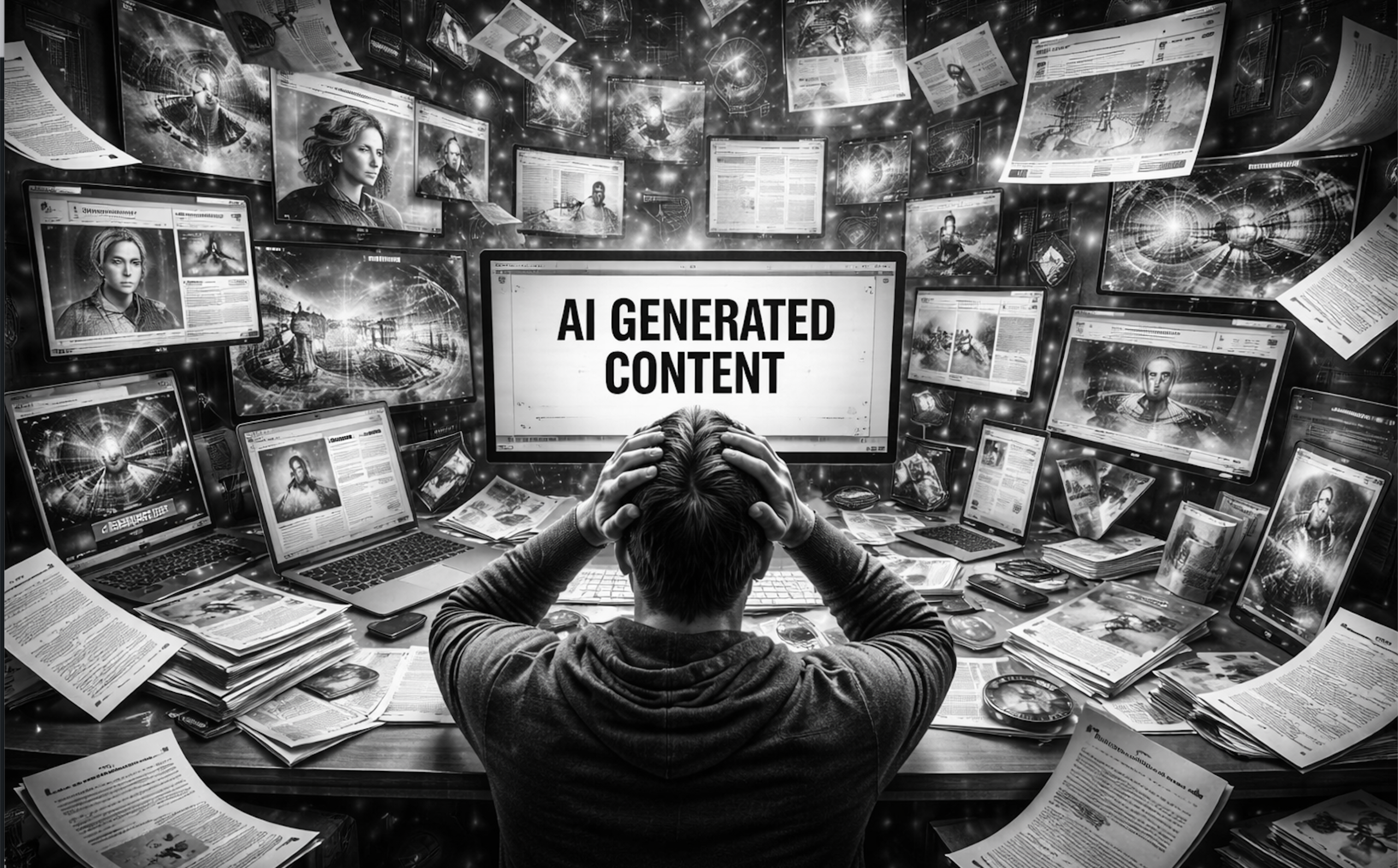
The promise of infinite, hyper-personalized, cheap volume is real. So is the risk: saturation, brands talking all the time, loss of narrative coherence. Without a strong human framework, AI doesn't amplify brand identity, it dilutes it. It multiplies outputs, but it doesn't build meaning.
The human role shifts from creator to strategic editor of meaning. Less compulsive production, more responsibility for the story, the tone and the direction.
Research, planning and media: intelligence without understanding
Applied to brand research and strategy, AI is probably where it becomes dominant fastest. Insight synthesis, cultural analysis, pattern detection, dynamic segmentation, scenario simulation. All of that is already happening and will deepen considerably in the short term.
But here's where one of the most delicate points Amodei raises appears: false certainty; systems that produce plausible, well-argued, tidy strategies that aren't necessarily true. The risk isn't a lack of intelligence, but an excess of confidence in it.
The planner of the future isn't the one who "finds the insight," but the one who knows when to distrust the insight generated by the machine, when to adjust, when to add human, cultural and emotional context that doesn't show up in the data or in the conclusions AI produces.
In digital media planning, the picture is less ambiguous: AI is going to win almost completely: optimization, bidding, segmentation, dynamic creative, attribution modeling. The risk isn't running out of work, but losing the capacity for strategic decision-making. Accepting what the system optimizes without asking what it's optimizing for: efficiency versus brand building, short term versus long-term value.
Power, maturity and the work ahead
AI's deepest impact on advertising isn't creative or operational, it's structural.
Following Amodei, the real risk isn't that AI makes campaigns, but who controls those systems. Platforms with AI built in concentrate power. Agencies with no judgment of their own become dispensable intermediaries. Value moves from making to deciding.
AI can elevate creative and strategic work or turn it into perfectly optimized automated noise.
To survive, agencies will need a great deal of strategic knowledge and a lot of courage to tell a client that their initial idea shouldn't be executed!, or that their brand, developed with AI, doesn't have the relevance and salience the market needs. Standing up to AI and winning these battles will be a fundamental requirement for those who want to stay profitable in this market.
What really changes in our work is this: less manual production, more design of AI-powered systems and processes; less "manual" execution, more editorial responsibility; less obsession with the tool, more importance placed on thinking with judgment.
As in Amodei's thesis, the outcome isn't written. Technology doesn't determine the result. The maturity with which it's used does.