by Federico Soto Roland – Strategy, AI & Digital Director @ NSB Agency
Today almost every market is saturated. Products look alike. Services are interchangeable. The differences brands believe they have are, in many cases, an internal illusion—declared by owners and marketing managers, but invisible to the consumer. And when they do exist, they often don't matter.
In the vast majority of the industries and segments we work in, brands communicate in almost identical ways: the same tones, the same stock phrases, the same forced acting of "lofty purpose," the same ideas about saving the world or urging the consumer to live life to the fullest. Almost like copy and paste: swap the logo and it's all the same.
The result? Brands lose salience. They don't stand out or differentiate from one another. They aren't remembered. Very few build any kind of real connection.
And that comes at a cost: your paid campaigns deliver less and less. You have to invest more to achieve less. And if you don't do something fundamental, you're heading straight into competing on price alone, with margins already in free fall. And remember this line: "a customer won on price is lost on price."
Enough chasing the smoke of the latest trend
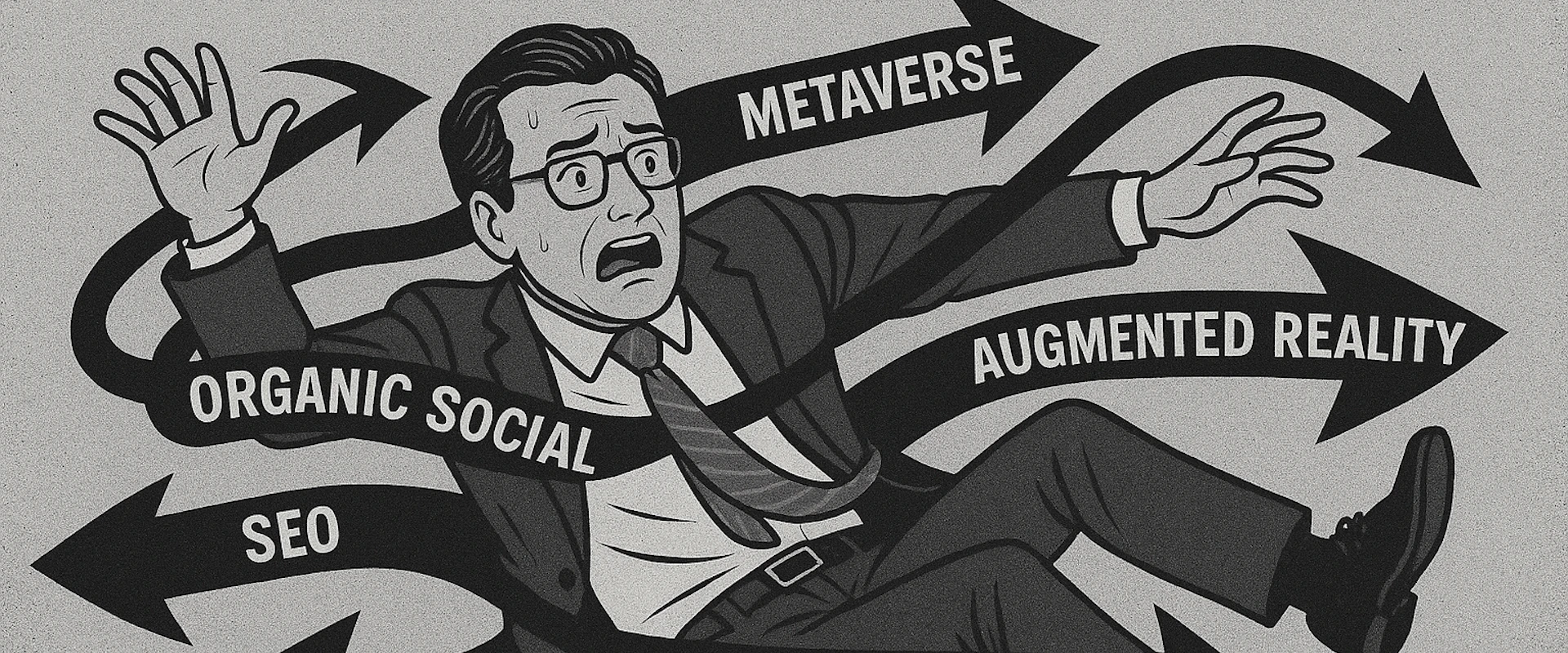
Instead of grabbing the wheel, many marketers are chasing the fad of the moment.
In Argentina's case, these "trends" are often just trickle-downs of what's happening in developed markets, widening the sense of distance from the reality brands and consumers actually live in the local market.
And so, in recent years we've seen the metaverse, organic social media as the one and only saving tool, "purpose that comes to save the world," NFTs, sustainability at all costs, or, right now, magic AI prompts.
In many brands, these trends turn into tools with no idea, no context, no strategy. There's no plan. There's anxiety and FOMO (fear of missing out).
Some trends are pure smoke (the metaverse, for example), others are only for specific brands and cases (augmented reality), and some hold real potential (AI, for instance), but what we see again and again are brands desperate to "jump on something" without even having the basics of their marketing properly sorted out.
The ABCs still work, even if they sound "boring," "conventional" and people tell you they're "so over"!
Here's the playbook for what really moves the business.
No glamour, no fluff or "buzzwords," but with results.
- Diagnosis
Want to grow? First look at where your brand and your product/service stand. What the market is doing, what the customer wants, how the competition moves and how it communicates. Not from inside your bubble. With real data, with street-level insight, with context, with rawness and unvarnished truth! (for that you'll need someone willing to tell you things you may not want to hear).
- Segmentation, targeting and positioning
You can't talk to everyone. Choose who you talk to and why they should care. To position is to take a clear stance. It's choosing a place in your audience's mind and owning it. Whoever tries to please everyone ends up irrelevant. It's having the courage to develop a voice of your own. Not chasing the "safe" and the average.
- Strategy before tactics
If your first meeting of the month is about deciding what to post on social media, you don't have a strategy. You have a calendar. First comes the destination. Then the GPS. Strategy is the key to everything that follows. Without it you can be doing a thousand things that make no real sense, wasting your marketing budget on doing—very often—the same thing everyone else does.
- The 4 Ps aren't dead
Product. Price. Place. Promotion (Brand). These are still the axes that determine whether you win or lose. Everything else—the "mission and vision" on your website, the TikTok campaign, the influencer of the moment, the ad everyone else is imitating—is makeup if these are shaky.
- Branding and performance: it's not one or the other, it's both
The study "The Long and the Short of It"—by Les Binet and Peter Field—is clear: if you want to grow, you have to invest 60% in building the brand and 40% in activating sales.
Only performance? Welcome to the world of the eternal discount, where you'll only generate short-term sales but no brand valuation to defend margins and expand your market over the long term.
Only branding? Your CFO will get nervous, and your sales team will be staring at the ceiling until demand comes back around.
But beware: one of the biggest conclusions of Binet and Field's study is that branding boosts performance campaigns, while performance campaigns have little impact on creating medium- and long-term brand value. Be careful with so much focus on the short term and the deal of the week! The balance isn't optional. It's mandatory.
Brands with no memory, consumers with no interest
The biggest sin today is inconsistency. Many brands change agencies and claims every 12 months. They change tone, focus and identity like someone updating their Instagram bio. Each new management team reinvents the brand to show it's doing something.
Real marketing isn't built on trends or urgencies. It's built on strategy, focus, sustained execution and long-term planning.
The essentials haven't changed.
What changed is the consumer's attention: today they have a billion stimuli and the channels have multiplied. Everyone got distracted. And if you have to choose, in a market where everything gets copied, where everything levels out, where products are clones and prices race to the bottom, the brand is the only thing that can save you.
The only real difference (unless you have an uncopyable patent or own a monopoly product/service!). If you don't have a brand, you don't have a business. You have a plank in the middle of a price war.
And spoiler: nobody wins that war … only the consumer, and here we're not selling the line that the consumer comes first … no! the first goal of any company is figuring out how to cover its costs and keep as much as possible left over to reward its shareholders, now and in the future! – everything else is playing to the gallery.